
As a movie about the past, and not only one historical event but two (the play and the original event), has a lot to tackle in terms of accuracy. As a primary source of the time it was made (1990s) and a secondary source of the time period it is representing (1600s and 1950s), the Crucible has layers upon layers of commentary and details to discuss. I have divided this page into my analysis of how this movie works as first a secondary source of the Witch Trials and McCarthyism, and second as a primary source of the time in which the movie was made – the 1990s.
Secondary Source – Witches and Fear
The Crucible has a major advantage that most other historical films do not get to have – they have the original author as their screenwriter. Arthur Miller was directly involved in the making of this film, so any changes made to the movie from the original play, he approved.1 So, as a representation of the original play, this movie has very little to comment on. To note, some of the changes that were made were
However, as a representation of the Salem Witch Trials, there is room for improvement. Though Miller makes changes on purpose (he cites a lack of documentation regarding the character changes), they are still made. The names of the characters are accurate, but the ages are different – Abigail Williams is aged up from 11 to 17, and John Proctor is aged down from his 60s to about 35 years of age. This was done to make the age difference between the two less egregious, as in the play and movie they have a sexual relationship at one point. Multiple judges are combined into two characters – Hathorne and Dansforth.
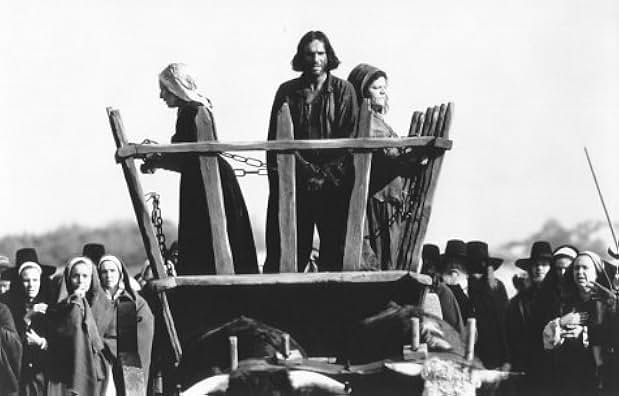
One of the major differences in this movie as a secondary source is its intentions behind the film. The original play was meant to be a commentary on what was happening during the time of its release – the Red Scare and McCarthyism. This movie was less of a commentary on that, and more of a metaphor for gender roles and the sexual freedom of women. As referenced in Zahra Sadeghi’s article, “Representation of Women in Nicholas Hytner’s The Crucible (1996),” sexual repression is the angle Hytner was taking.2 In this way, the motivation for this film differed, but still represented the overall play in a relatively accurate manner.
Primary Source – The 90’s
Nicholas Hytner was no stranger to a commentary on current events. Choosing the Crucible, a movie already known for its commentary on the events happening at the time of its production, makes this movie an excellent one to choose. In this movie, however, the commentary is not on McCarthyism, but on 1990’s sexual freedom. By nature, the plot of this movie already tackles concepts like women’s freedom, mysogyny, and repression. Nicholas Hytner, the director, decided to lean more heavily into 1990s policics, rather than the 1950s.
In this time, Clinton’s scandal was going on in the press – and this had a direct impact on the production of the movie.3 Through the scenes in the woods and the implications of John Proctor and Abigail Williams’ sexual relationship, this movie makes very clear its attempt to show how a woman’s power was perceived at the time. Abigail does everything she does because she wants to be with John Proctor. She is consumed by her lust for him, and in a way this gives her freedom over her actions. This shows how at the time of the original play (1953) but when the movie was released (1996) that women were displaying their power in different ways.
Conclusions
This movie did a good job portraying what it intended to portray. I think, because Arthur Miller had a very direct hand in the making of the movie, that it is hard to cast judgement on the changes made, as he added them in and approved them. I do believe that as a primary source of the 1990s that this is a new angle I had not heard of – the way women are portrayed in film are always a fickle thing. In the 1996 movie, I do think the commentary on McCarthyism is lost, but that is replaced by the commentary on 1990’s American culture, so I do not believe it was a mistake or a downfall.
*Though these are my own words, in the Citations page I have every source I consulted or referenced listed, including pictures.*
Footnotes:
- Gates, David, and Yahlin Chang. “One Devil of a Time.” Newsweek 128, no. 23 (December 2, 1996): 76. https://research-ebsco-com.umw.idm.oclc.org/linkprocessor/plink?id=a24ae45f-43ad-3ab6-ab33-3d1124f570e6.
- Sadeghi, Zahra. “Representation of Women in Nicholas Hytner’s The Crucible (1996).” Quarterly Review of Film and Video 36, no. 2 (February 1, 2019): 140–52. doi:10.1080/10509208.2018.1527146.
- Sadeghi 140